


Artificial intelligence leader OpenAI has taken its first concrete step toward a potential initial public offering (IPO) by submitting a confidential S-1 registration. The move marks a significant milestone for the company, though its leadership remains cautious about the path forward. In a recent announcement on X, OpenAI acknowledged the complexities of going public, emphasizing that the decision involves balancing multiple strategic considerations.
The company’s measured tone reflects the challenges of transitioning from a private to a public entity. While OpenAI recognizes the advantages of remaining private—such as greater flexibility in pursuing long-term goals—it has not ruled out an earlier listing if circumstances align favorably. This cautious approach underscores the high stakes involved in what could be one of the most closely watched IPOs in the tech sector.
OpenAI’s hesitation to commit to a specific timeline stems from several key factors. The company’s leadership has openly described the decision to go public as a “complicated set of tradeoffs,” suggesting that internal deliberations are ongoing. One major consideration is the competitive landscape, particularly the recent IPO filing by rival Anthropic.
Anthropic’s move to file its own IPO paperwork has added urgency to OpenAI’s decision-making process. Currently, Anthropic appears to hold an edge, thanks to its more efficient cost structure and faster revenue growth. This dynamic puts OpenAI in a difficult position: attempting to go public ahead of Anthropic could be logistically challenging, while following too closely might invite unfavorable comparisons.
For OpenAI, remaining private offers certain advantages, such as the ability to focus on innovation without the pressures of quarterly earnings reports. However, going public could provide access to additional capital, enhancing its ability to scale operations and invest in cutting-edge research. The company’s leadership must weigh these benefits against the potential drawbacks, including increased regulatory scrutiny and shareholder expectations.
An OpenAI IPO would have far-reaching consequences for the AI industry and the broader tech ecosystem. As one of the most influential companies in artificial intelligence, its transition to public markets could set a precedent for other AI startups. Investors and analysts are closely monitoring the situation, eager to see how OpenAI navigates the complexities of this process.
The timing of an IPO is often influenced by market conditions, and OpenAI’s case is no exception. With economic uncertainty lingering, the company must assess whether current market sentiment is favorable for a successful debut. A poorly timed IPO could result in underwhelming valuations or investor skepticism, making this a critical factor in OpenAI’s decision-making.
Beyond financial and competitive factors, OpenAI must also consider the regulatory and ethical implications of going public. As a leader in AI development, the company faces heightened scrutiny over its practices, from data privacy to the ethical use of its technologies. Public markets may demand greater transparency, requiring OpenAI to strike a balance between innovation and accountability.
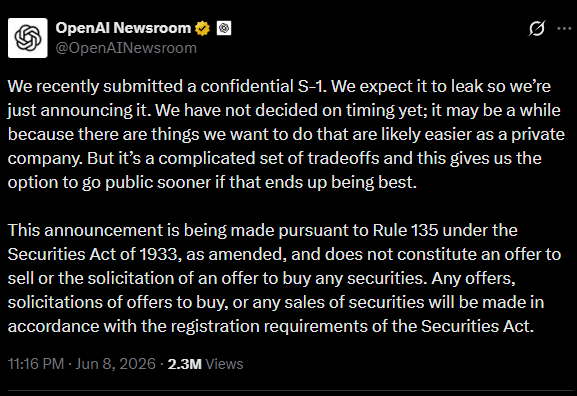
While OpenAI’s S-1 filing signals its intent to explore a public offering, the company has not provided a definitive timeline. The lack of clarity suggests that internal discussions are still underway, with leadership carefully evaluating the best path forward. Observers will be watching closely to see whether OpenAI accelerates its plans or adopts a more cautious approach.
Several outcomes are possible in the coming months. OpenAI could proceed with an IPO relatively quickly, aiming to capitalize on its current momentum. Alternatively, it might delay the process to address internal or external challenges, such as improving its financial position or waiting for more favorable market conditions. Another possibility is that the company could explore alternative funding options, such as private investments or partnerships, to avoid the pressures of public markets.
OpenAI’s co-founders and executive team play a pivotal role in determining the company’s next steps. Their ability to navigate the complexities of an IPO—while maintaining the company’s innovative edge—will be crucial. Leadership decisions will not only impact OpenAI’s future but also shape the broader AI industry’s trajectory.
An S-1 registration is a filing required by the U.S. Securities and Exchange Commission (SEC) for companies planning to go public. It provides detailed financial and operational information, allowing investors to evaluate the company’s prospects. For OpenAI, this filing marks the first formal step toward a potential IPO.
Anthropic’s IPO filing adds competitive pressure on OpenAI. Since Anthropic appears to have a stronger financial position, OpenAI must carefully consider whether to proceed with its own IPO before or after its rival to avoid unfavorable comparisons.
Going public too soon could expose OpenAI to market volatility, investor scrutiny, and regulatory challenges. It might also limit the company’s flexibility in pursuing long-term goals, as public companies often face pressure to deliver short-term results.
OpenAI’s decision to file an S-1 registration is a significant development, signaling its potential transition to public markets. However, the company’s cautious approach highlights the complexities involved in such a move. From competitive pressures to market conditions and regulatory considerations, OpenAI must navigate a range of challenges before finalizing its IPO plans.
As the AI industry continues to evolve, OpenAI’s next steps will be closely watched by investors, competitors, and industry observers. Whether the company proceeds with an IPO or opts for an alternative path, its decisions will have a lasting impact on the future of artificial intelligence and the tech sector as a whole.






