


Microsoft’s latest breakthrough, SkillOpt, demonstrates how a single trained Markdown file can enhance the capabilities of advanced AI models like GPT-5.5 by over 20% on procedural tasks. This innovative approach, developed in collaboration with three Chinese universities, transforms static instruction documents into dynamic, optimizable assets—mirroring the training process of neural network weights. By treating these "skills" as trainable components, SkillOpt bridges the gap between manual crafting and automated optimization, delivering measurable improvements without altering the underlying model.
Traditionally, AI skills—bundles of procedures, tool-use rules, and output formats—have been created through manual effort, one-time model generation, or self-revision. However, these methods lack the precision of true optimization. SkillOpt changes the game by introducing a systematic training process where a secondary language model refines the skill document based on performance data. The result? A lightweight, transferable solution that boosts efficiency across diverse tasks and models.
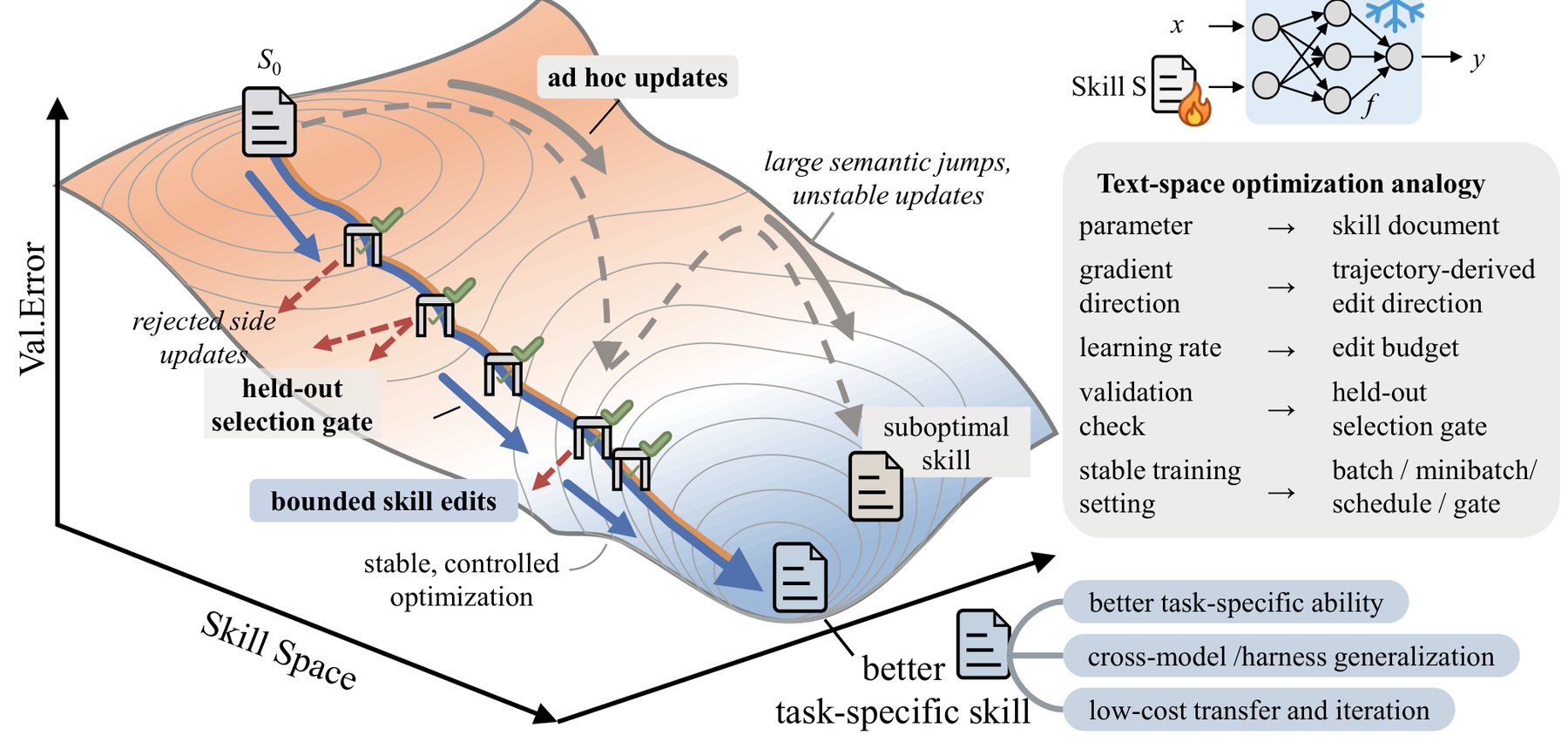
SkillOpt redefines the role of instruction documents by treating them as external, trainable states for a frozen target model. Unlike conventional methods, this approach employs a separate language model to analyze execution logs, identify patterns, and propose targeted edits—such as adding, deleting, or modifying passages. Each change undergoes validation, ensuring only performance-enhancing adjustments are retained. This process mirrors deep learning techniques, with mechanisms like a “learning rate” to control edit volume and a scheduler to refine step sizes over time.
The system also incorporates a buffer for rejected edits, using them as negative examples to prevent repetitive mistakes. A final slow update at the end of each epoch stabilizes improvements, similar to gradient smoothing in traditional training. This structured approach ensures that the skill document evolves methodically, rather than through arbitrary revisions.
One of SkillOpt’s key advantages is its clean separation between training and deployment. The optimizer model operates exclusively during the training phase, leaving the target model untouched. Once training is complete, the optimized skill—a concise Markdown file of 300 to 2,000 tokens—is fed to the target model as context. This simplicity ensures seamless integration without additional computational overhead during inference.
SkillOpt’s effectiveness was tested across six benchmarks, including search, spreadsheets, document analysis, math, and embodied action. The target models ranged from GPT-5.5 to the smaller Qwen3.5-4B, with evaluations conducted in both direct chat and agent environments like Codex and Claude Code. The results were unequivocal: SkillOpt consistently led or matched the best-performing comparison methods, including handwritten skills, one-shot LLM-generated skills, and specialized techniques like Trace2Skill and TextGrad.
On GPT-5.5, the average performance improvement across all benchmarks reached approximately 23 points. The most significant gains appeared in tasks with strict formatting requirements, such as spreadsheet editing, where procedural knowledge is critical. Even smaller models benefited, suggesting that well-trained skills compensate for gaps in their pre-trained weights.
A standout feature of SkillOpt is its transferability. Skills trained on larger models proved effective for smaller models within the same family. For instance, a spreadsheet skill optimized in the Codex environment performed equally well in Claude Code, eliminating the need for retraining. Similarly, a math skill trained on olympiad problems delivered improvements on related benchmarks without additional adjustments.
Ablation studies underscored the importance of SkillOpt’s design elements. Removing the edit budget led to unstable revisions, while eliminating the buffer for rejected edits caused repetitive errors. The most dramatic performance drop—over 20 points on SpreadsheetBench—occurred when the slow update at the end of each epoch was omitted. These findings highlight how the combination of bounded edits, validation gating, and long-term consolidation creates a controlled optimization process.
Despite their impact, SkillOpt’s final skill documents remain remarkably concise, rarely exceeding 2,000 tokens. This efficiency contrasts with bulkier alternatives, proving that targeted, well-structured instructions can drive significant improvements without unnecessary complexity. The readability of these documents also ensures they remain adaptable for human review or further refinement.
SkillOpt is a method developed by microsoft that optimizes AI instruction documents, or "skills," through a systematic training process. By treating these documents as trainable components, it enhances model performance on procedural tasks by over 20% without modifying the underlying AI architecture.
Yes, one of SkillOpt’s key advantages is transferability. Skills optimized on larger models often improve performance in smaller models within the same family, and they can function effectively across different environments without retraining.
SkillOpt delivers the most significant improvements in tasks with strict formatting requirements, such as spreadsheet editing, tool use, and procedural workflows. However, it also enhances performance in document analysis, math, and embodied action tasks.
Microsoft’s SkillOpt represents a paradigm shift in AI optimization, proving that a single trained Markdown file can unlock substantial performance gains. By transforming static instruction documents into dynamic, trainable assets, this method bridges the gap between manual crafting and automated refinement. The results speak for themselves: consistent improvements across benchmarks, transferable skills, and efficient, readable documents that do more with less.
As AI models continue to evolve, techniques like SkillOpt offer a scalable, cost-effective way to enhance their capabilities without overhauling their architecture. Whether for enterprise applications or research, this innovation paves the way for smarter, more adaptable AI systems—all through the power of a well-optimized Markdown file.






