


Microsoft’s latest breakthrough in artificial intelligence demonstrates that precision often trumps sheer power when training advanced image generators. The tech giant’s research division has unveiled Lens, a text-to-image model designed to rival much larger systems while consuming significantly fewer computational resources. Unlike traditional approaches that rely on massive datasets and brute-force processing, Lens achieves impressive results through meticulous data curation and architectural innovation.
This development challenges the prevailing assumption that bigger models always yield better outcomes. By prioritizing high-quality captions and optimized training methods, Microsoft Research has created a system that punches above its weight class. The implications extend beyond academic curiosity, potentially reshaping how future AI models are developed and deployed across industries.
At the core of Lens’s efficiency lies its carefully constructed training dataset. The Lens-800M collection contains 800 million image-text pairs, each accompanied by captions averaging 100 words—far more descriptive than typical web-scraped alt text. These rich descriptions, generated by GPT-4.1, provide the model with precise contextual information during training.
Microsoft’s ablation studies confirm that longer captions consistently produce superior results compared to shorter or mixed descriptions. Standard alt text often contains inaccuracies or vague language, which can dilute the learning process. By contrast, Lens’s detailed captions create a stronger learning signal, enabling the model to grasp nuanced visual concepts more effectively.
The research team explored multiple architectural approaches to optimize performance. Their experiments with variational autoencoders (VAEs) revealed that FLUX.2’s semantic VAE delivered the best results, both in terms of image quality and training speed. This component handles the critical task of translating between pixels and compressed image representations.
For language processing, Lens employs GPT-OSS, an open-source model from OpenAI. This choice proved advantageous in two key ways: it accelerated the learning process and enabled multilingual capabilities. Despite being trained exclusively on English image-text pairs, Lens can interpret prompts in Chinese, French, Japanese, and Spanish. The stronger language encoder also enhanced the model’s ability to faithfully reproduce complex prompts.
Following initial training, Lens undergoes a reinforcement learning phase using a specialized prompt set called Lens-RL-8K. This collection covers ten distinct categories, including people, animals, landscapes, food, and fictional scenes. For each prompt, GPT-4.1 generates corresponding evaluation criteria, while a smaller GPT-4.1-mini model serves as the reward mechanism.
The research demonstrates that prompt diversity matters more than sheer volume. When certain categories, such as text-heavy prompts, were removed from the reinforcement learning set, performance in those areas declined. This finding underscores the importance of comprehensive training across various visual domains.
Microsoft implemented a reasoning component that acts as an intermediary between users and the image generation model. This system, typically powered by GPT-5.5, refines ambiguous user inputs into detailed, structured prompts. Interestingly, the team found that GPT-OSS—the same model used as the text encoder—could perform this task without requiring additional memory.
The researchers also developed a method to iteratively improve the reasoner’s system prompt without retraining. This approach proved transferable to larger models like Qwen-Image, suggesting broader applicability across different AI systems.
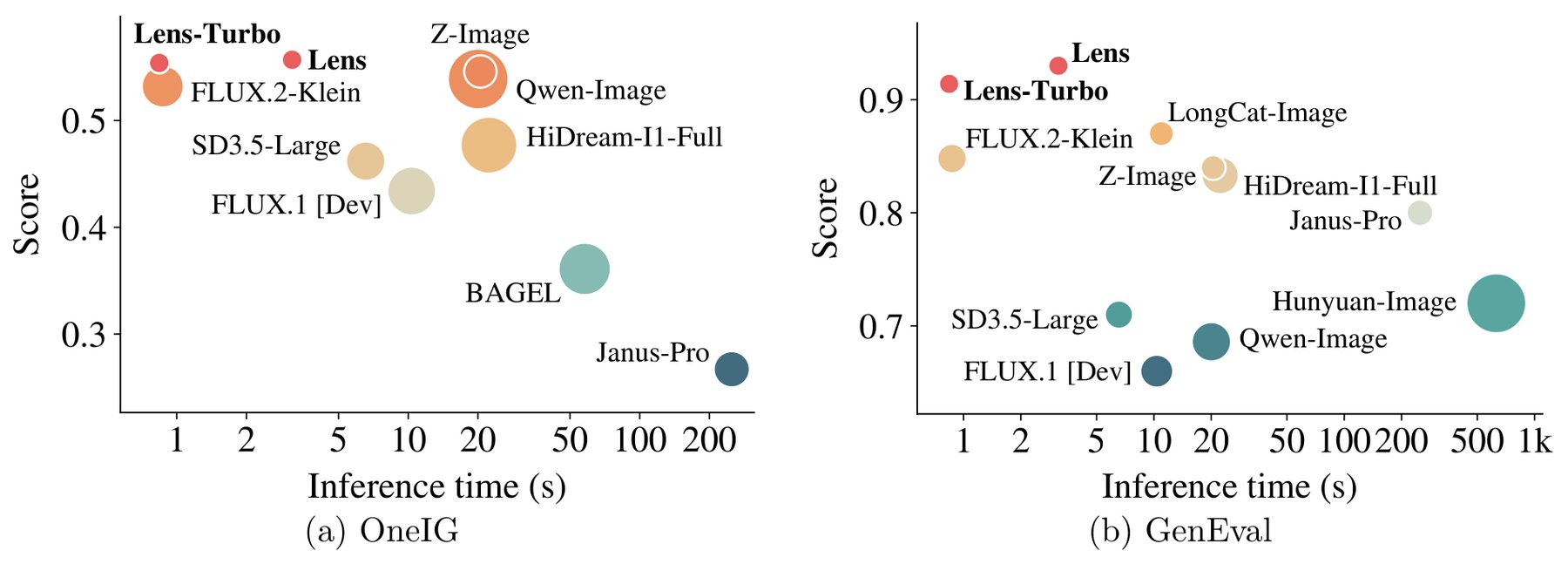
To address the need for faster inference times, Microsoft created Lens-Turbo, a distilled version of the original model. While the standard Lens model generates a one-megapixel image in approximately three seconds on an H100 GPU, Lens-Turbo accomplishes the same task in under a second—requiring just four processing steps.
Benchmark tests reveal that Lens outperforms competing models like FLUX.2-Klein and Z-Image in several key areas, including prompt fidelity and text rendering. The model’s ability to handle complex scenes while maintaining high quality sets it apart from many larger alternatives.
One of Lens’s most impressive features is its ability to generalize across different image formats and resolutions. Despite being trained on a fixed set of image sizes, the model can produce outputs up to two megapixels without requiring additional high-resolution training data. This adaptability stems from the team’s decision to include various aspect ratios—from portrait to landscape—in each training batch.
This approach not only saves computational resources but also ensures consistent performance across diverse use cases. Whether generating social media content, marketing materials, or detailed illustrations, Lens maintains its quality standards without the need for specialized training runs.
Lens achieves comparable or superior results to much larger models while using only a fraction of the computational resources. Its 3.8 billion parameters outperform systems with tens of billions of parameters in several benchmarks.
Lens uses captions averaging 100 words, generated by GPT-4.1, which provide far more detailed and accurate descriptions than typical web-scraped alt text. This richness enhances the model’s learning efficiency.
Yes, despite being trained only on English image-text pairs, Lens can interpret prompts in multiple languages, including Chinese, French, Japanese, and Spanish, thanks to its advanced text encoder.
Microsoft Research’s Lens model represents a significant shift in how efficient AI image generation can be achieved. By focusing on high-quality captions, optimized architecture, and targeted training methods, the team has demonstrated that smaller models can compete with—and even surpass—larger counterparts in specific tasks.
The success of Lens and its distilled variant, Lens-Turbo, suggests that future AI development may prioritize data quality and architectural innovation over sheer scale. This approach not only reduces computational costs but also makes advanced image generation more accessible to organizations with limited resources.
As the field of AI continues to evolve, Microsoft’s research offers valuable insights into building more sustainable and effective models. The principles behind Lens could influence the next generation of text-to-image systems, making them faster, more versatile, and more efficient than ever before.






