

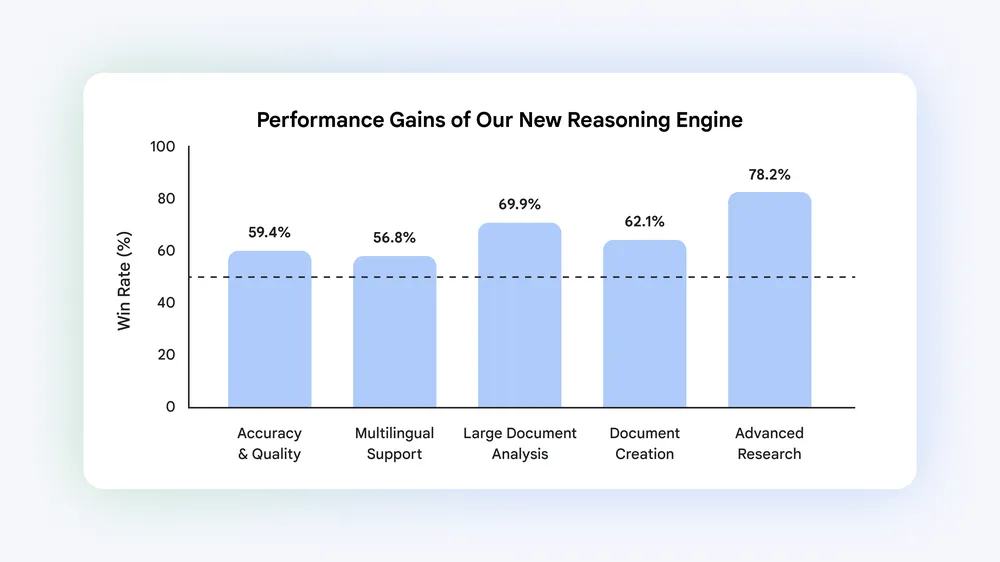
Google’s NotebookLM has undergone a major transformation, emerging as a fully autonomous cloud-based AI research assistant. The latest iteration leverages Gemini 3.5 Flash alongside Google’s Antigravity coding framework, granting each notebook its own dedicated cloud environment capable of executing code and managing complex, agent-driven workflows. According to Google, internal benchmarks show the upgraded system outperforming its predecessor in 65% of test cases, marking a significant leap in AI-assisted research capabilities.
This evolution positions NotebookLM as more than just a note-taking tool—it’s now a dynamic workspace where users can generate, refine, and execute projects with minimal manual intervention. The platform’s new features streamline the research process, allowing seamless exports into PDF reports, Excel spreadsheets, PowerPoint presentations, and image files. Additionally, a zero-source mode enables NotebookLM to autonomously locate and integrate relevant sources from Google Search, further reducing the need for manual input.
NotebookLM’s most groundbreaking upgrade is its shift to a cloud-native architecture. Each notebook now operates within its own isolated cloud environment, equipped with the ability to write, test, and run code independently. This self-contained setup eliminates the need for external development tools, allowing researchers, developers, and analysts to execute tasks directly within the platform. The integration of Antigravity, Google’s proprietary coding framework, ensures smooth code generation and debugging, making it ideal for both technical and non-technical users.
The introduction of agent-based capabilities takes NotebookLM beyond simple automation. Users can now deploy AI agents to handle multi-step research tasks, such as data collection, analysis, and report generation, without constant supervision. These agents operate in tandem, breaking down complex projects into manageable subtasks while maintaining context across the entire workflow. For example, a researcher studying market trends could task NotebookLM with gathering data, cleaning datasets, generating visualizations, and compiling a final report—all within a single notebook.
One of NotebookLM’s standout improvements is its expanded export functionality. Users can now convert their findings into polished, professional formats, including:
– PDF reports with embedded charts and graphs
– Excel spreadsheets for raw data and calculations
– PowerPoint presentations for visual storytelling
– High-resolution image files for infographics
The zero-source mode further enhances productivity by automatically sourcing and citing relevant information from google Search, ensuring accuracy and saving time. This feature is particularly useful for academics, journalists, and business analysts who rely on up-to-date, verifiable data.
For scholars and scientists, NotebookLM’s autonomous research capabilities are a game-changer. The platform can handle literature reviews, data analysis, and even draft sections of research papers, allowing users to focus on higher-level thinking. The ability to export findings in multiple formats also simplifies the process of sharing results with peers or submitting work for publication.
Developers can leverage NotebookLM’s cloud-based code execution to prototype ideas, test algorithms, and debug scripts without leaving the platform. The integration with Antigravity provides a robust coding environment, while agent-based workflows enable rapid iteration on complex projects. Data scientists, in particular, will appreciate the seamless transition from raw data to visualizations and reports.
Corporate users can harness NotebookLM to streamline market research, competitive analysis, and internal reporting. The zero-source mode ensures that insights are backed by credible data, while the export options allow for easy integration into business presentations. Teams can collaborate more efficiently, with AI agents handling repetitive tasks like data aggregation and preliminary analysis.
Google’s latest update to NotebookLM signals a broader shift toward fully autonomous AI research tools. By combining cloud-based execution, agent-driven workflows, and seamless output generation, the platform sets a new standard for AI-assisted productivity. While the current version is limited to Google AI Ultra and Workspace customers with specific access tiers, the potential for wider adoption is clear.
As AI continues to evolve, tools like NotebookLM could redefine how professionals approach complex tasks. The ability to offload repetitive or time-consuming work to AI agents frees up human users to focus on creativity, strategy, and decision-making. For now, early adopters are already experiencing the benefits of a more intelligent, self-sufficient research assistant.
Google NotebookLM is an AI-powered research tool that now operates as a cloud-based workspace. It can execute code, manage agent-driven workflows, and generate reports, spreadsheets, and presentations autonomously.
The new features are available to Google AI Ultra and Workspace customers with AI Ultra Access or AI Expanded Access. It is not yet available to the general public.
Zero-source mode allows NotebookLM to automatically search for and integrate relevant sources from Google Search into your research. This ensures that your work is backed by credible, up-to-date information without manual input.
While NotebookLM significantly enhances productivity, it is designed to assist rather than replace human researchers. It excels at handling repetitive tasks, data analysis, and preliminary research, but critical thinking and final decision-making still require human oversight.
Google’s NotebookLM has evolved from a simple note-taking tool into a sophisticated, cloud-based AI research assistant. With its ability to execute code, manage agent-driven workflows, and generate professional outputs, it represents a major advancement in AI-assisted productivity. The platform’s new features cater to a wide range of users, from researchers and developers to business professionals, offering tools that streamline workflows and enhance collaboration.
As AI continues to integrate deeper into professional workflows, tools like NotebookLM will play an increasingly vital role. While the current version is limited to select Google customers, its potential impact on research, development, and business analysis is undeniable. For those with access, NotebookLM is poised to become an indispensable part of their toolkit, bridging the gap between human creativity and machine efficiency.






