


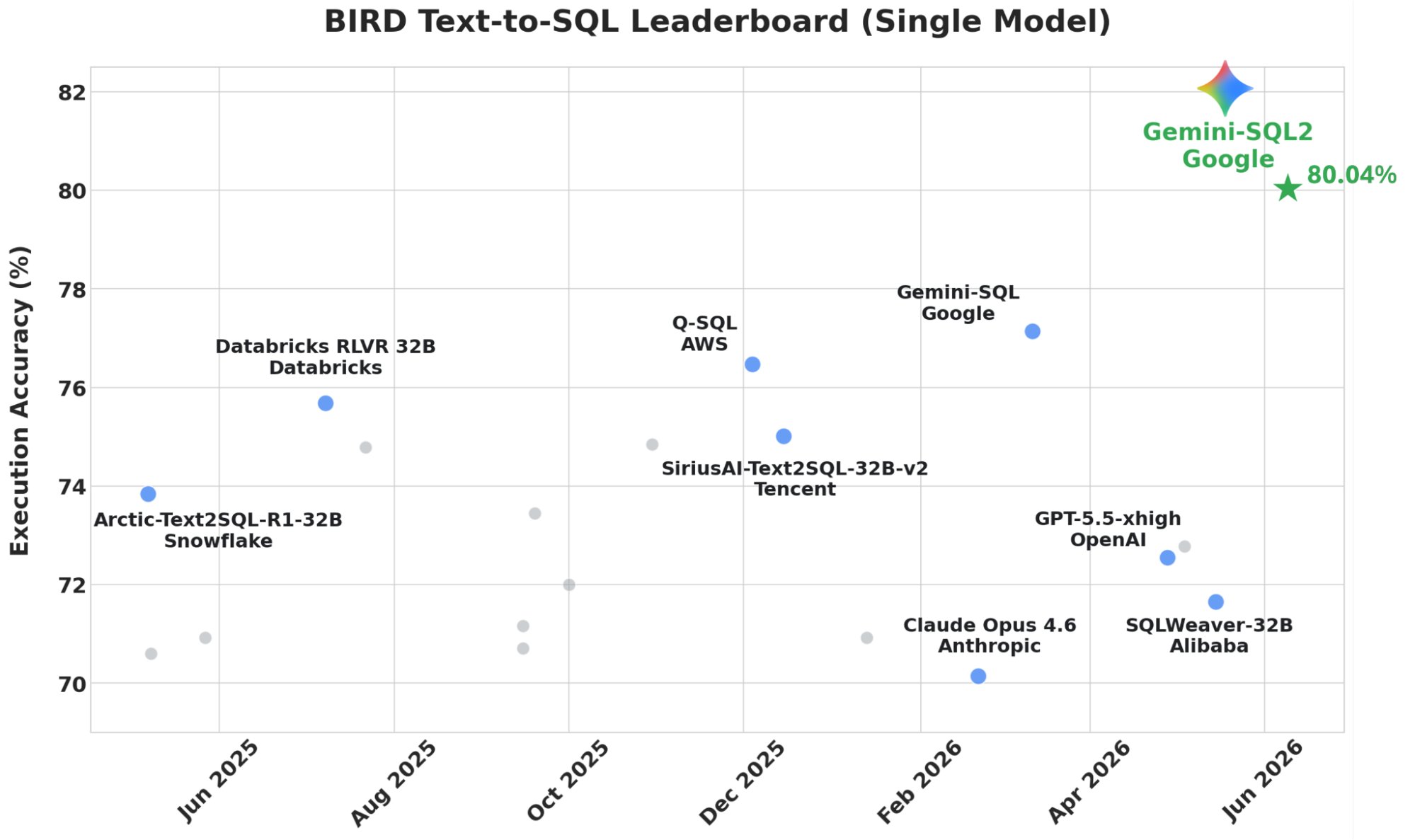
Natural language processing has taken another leap forward with Google Research’s latest innovation, Gemini-SQL2. This cutting-edge text-to-SQL system, built on the foundation of Gemini 3.1 Pro, is redefining how machines interpret human queries into executable database commands. The breakthrough comes as Gemini-SQL2 achieves an unprecedented execution accuracy of 80.04% on the BIRD benchmark, setting a new standard in the field.
The ability to convert everyday language into precise SQL queries has long been a challenge for AI systems, particularly when dealing with complex datasets and layered business logic. Google’s achievement not only surpasses existing models but also highlights the growing potential of AI-driven data interaction. With this advancement, the tech giant is paving the way for more intuitive and efficient database management tools.
Gemini-SQL2’s performance on the BIRD benchmark is nothing short of remarkable. Scoring 80.04% in execution accuracy, it leaves its closest competitors far behind. OpenAI’s GPT-5.5-xhigh trails at 72.8%, while Anthropic’s Claude Opus 4.6 achieves 70.9%. Other industry players, including Databricks, AWS, Tencent, and Alibaba, fail to come close to Google’s latest offering.
This margin of victory underscores the sophistication of Gemini-SQL2’s architecture. Unlike traditional models that struggle with nuanced queries, this system demonstrates an exceptional ability to generate SQL commands that are both syntactically correct and functionally executable. The result is a more reliable and efficient translation of natural language into database operations.
Google Research attributes Gemini-SQL2’s success to its advanced understanding of complex data structures and business logic. Many text-to-SQL systems falter when faced with multi-layered datasets or intricate query requirements. However, Gemini-SQL2 excels in these scenarios, producing outputs that align closely with human expectations.
The system’s foundation, Gemini 3.1 Pro, plays a crucial role in its performance. This underlying model provides the necessary computational power and contextual awareness to handle the nuances of natural language. By leveraging these capabilities, Gemini-SQL2 ensures that generated SQL queries are not only accurate but also optimized for real-world applications.
One of the most significant benefits of Gemini-SQL2 is its potential to democratize data access. By simplifying the process of converting natural language into SQL, Google is making it easier for non-technical users to interact with databases. This could lead to more widespread adoption of data-driven decision-making across industries.
Google has hinted that improved SQL understanding could enhance natural language features in its suite of data services. While the company has not yet announced a public release or published a research paper, the implications are clear. Businesses and developers alike stand to benefit from more intuitive and powerful data tools.
The success of Gemini-SQL2 raises important questions about the future of AI in database management. As models become more adept at interpreting complex queries, the need for manual SQL coding may diminish. This shift could accelerate the development of no-code and low-code platforms, empowering users with limited technical expertise to harness the full potential of their data.
Moreover, the competitive landscape is likely to evolve rapidly. With Google setting a new benchmark, other tech giants will undoubtedly push the boundaries of their own text-to-SQL systems. This healthy competition could drive further innovations, ultimately benefiting end-users with more accurate, efficient, and user-friendly tools.
Gemini-SQL2 is a text-to-SQL system developed by Google Research, designed to convert natural language queries into executable SQL commands. It is built on the Gemini 3.1 Pro model and currently leads industry benchmarks in execution accuracy.
Gemini-SQL2 outperforms competitors like OpenAI’s GPT-5.5-xhigh and Anthropic’s Claude Opus 4.6, achieving 80.04% execution accuracy on the BIRD benchmark. This is significantly higher than the scores of other leading models.
Google Research has not announced a public release or provided details about the availability of Gemini-SQL2. As of now, it remains a research project with no confirmed plans for wider distribution.
Google’s Gemini-SQL2 represents a major milestone in the evolution of text-to-SQL technology. By achieving an execution accuracy of 80.04% on the BIRD benchmark, it has set a new standard for the industry, outperforming established models from OpenAI, Anthropic, and other leading companies. This breakthrough is not just a testament to Google’s technical prowess but also a glimpse into the future of AI-driven database management.
The implications of this advancement extend far beyond the realm of research. With the potential to enhance data accessibility and streamline database interactions, Gemini-SQL2 could revolutionize how businesses and individuals engage with data. While the system’s public availability remains uncertain, its impact on the industry is undeniable. As AI continues to evolve, innovations like Gemini-SQL2 will play a pivotal role in shaping the next generation of data tools.






