


AI language models have long relied on sequential token generation, producing text one word at a time. Google’s latest innovation, DiffusionGemma, breaks this mold by introducing a diffusion-based approach that generates entire blocks of text simultaneously. This experimental model processes 256 tokens in parallel, offering significant speed improvements while opening doors to new applications in non-linear text manipulation.
Unlike traditional autoregressive models, DiffusionGemma starts with random noise and refines it into coherent text through multiple passes. This method, inspired by image-generation AI, allows for more efficient GPU utilization and faster processing speeds. However, the trade-off comes in output quality, as the model currently lags behind conventional alternatives in accuracy benchmarks.
Most language models predict the next word based on previous context, creating a linear progression. DiffusionGemma flips this concept by beginning with 256 random tokens and iteratively refining them into meaningful content. This approach mirrors how diffusion models in image AI transform static into detailed visuals, but applied to text generation instead.
The model’s architecture includes 26 billion total parameters, though only 3.8 billion activate per step. This efficiency stems from a mixture-of-experts design, where specialized sub-networks activate only when relevant to the input. When optimized for lower precision, DiffusionGemma fits within 18GB of VRAM on high-end consumer GPUs, making it accessible for local development.
Nvidia’s involvement in optimizing DiffusionGemma highlights its hardware-friendly design. Traditional autoregressive models often struggle with memory bandwidth limitations, leaving GPU compute units underutilized. By processing tokens in parallel, DiffusionGemma shifts the bottleneck from memory to raw compute power, keeping GPUs fully engaged.
Performance metrics demonstrate this advantage:
– 1,000 tokens per second on an Nvidia H100
– 800 tokens per second on DGX Station
– Over 700 tokens per second on GeForce RTX 5090
In single-user mode on dedicated GPUs, the model achieves speeds up to four times faster than comparable autoregressive models. However, this speed comes with a caveat—google’s benchmarks show DiffusionGemma trailing in text quality across all evaluated metrics.
While DiffusionGemma may not match the precision of traditional models, its unique approach excels in non-linear tasks. Because it processes entire blocks of text simultaneously, each token can reference any other token in the sequence—including those that appear later. This capability unlocks new possibilities:
– Inserting text into existing paragraphs without disrupting flow
– Filling gaps in program code with contextual awareness
– Solving structured problems like Sudoku puzzles
– Working with complex data formats such as amino acid sequences
Google’s example of a fine-tuned DiffusionGemma solving Sudoku demonstrates this strength. Autoregressive models struggle with such tasks because each decision depends on future context, which they cannot access during generation.
The primary limitation of DiffusionGemma lies in its output quality. For applications where accuracy is critical, Google still recommends its standard Gemma 4 models. The diffusion-based approach currently serves best as a research tool or for developers experimenting with fast, local workflows.
Another consideration is scalability. In cloud environments with multiple parallel requests, autoregressive models already maximize hardware efficiency. DiffusionGemma’s parallel processing can actually increase costs in these scenarios, making it less ideal for large-scale deployments.
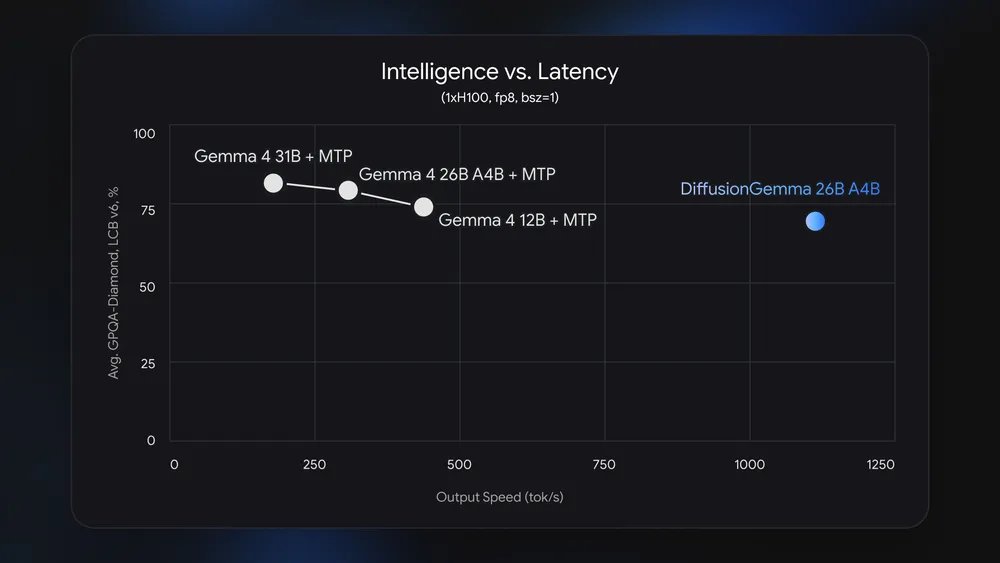
DiffusionGemma’s most notable advantage is its speed. By generating 256 tokens at once, it significantly outperforms sequential models in single-user scenarios. However, this performance boost comes at the expense of text quality. Google’s internal tests show the model lagging behind Gemma 4 in every quality benchmark, though the gap may narrow with future refinements.
The model’s mixture-of-experts architecture keeps memory demands manageable. At lower precision, it runs on consumer-grade GPUs with 18GB of VRAM, making it accessible for local development. This contrasts with many large language models that require enterprise-grade hardware for optimal performance.
DiffusionGemma is not a one-size-fits-all solution. Its ideal applications include:
– Rapid prototyping and experimentation
– Tasks requiring non-linear text manipulation
– Scenarios where speed outweighs absolute precision
– Local development environments with dedicated GPUs
For high-stakes applications where accuracy is paramount, traditional autoregressive models remain the better choice.
Unlike models that generate text word by word, DiffusionGemma starts with random noise and refines it into text in parallel blocks of 256 tokens. This approach enables faster processing but currently produces lower-quality output.
The model can run on high-end consumer GPUs with at least 18GB of VRAM when quantized to lower precision. Enterprise GPUs like Nvidia’s H100 offer the best performance.
Not yet. While it excels in speed and non-linear tasks, its output quality lags behind traditional models. Google positions it as a tool for research and experimentation rather than production deployment.
Google’s DiffusionGemma represents a bold departure from conventional text generation methods. By adopting a diffusion-based approach, the model achieves remarkable speed improvements while introducing new capabilities for non-linear text manipulation. Though it currently falls short in output quality, its potential for tasks like code completion and structured problem-solving makes it a valuable tool for researchers and developers.
As AI language models continue to evolve, DiffusionGemma highlights the trade-offs between speed and precision. While it may not replace traditional models in all scenarios, its innovative approach opens doors to new applications and workflows. Future iterations could bridge the quality gap, making diffusion-based text generation a mainstream alternative in the AI landscape.






