


Artificial intelligence is reshaping how Americans view their careers and cognitive abilities, with a groundbreaking survey uncovering deep-seated fears. Over half of U.S. adults worry that AI could replace their jobs or diminish their capacity for independent thought, according to findings from Anthropic. The study, which polled nearly 52,000 people, highlights a nation grappling with the dual promise and peril of rapidly advancing technology.
While AI’s potential to revolutionize healthcare and daily life offers hope, concerns about economic displacement and mental reliance dominate public sentiment. The survey reveals a stark divide between optimism for AI’s benefits and apprehension about its societal impact, particularly in workplaces where automation threatens traditional roles.
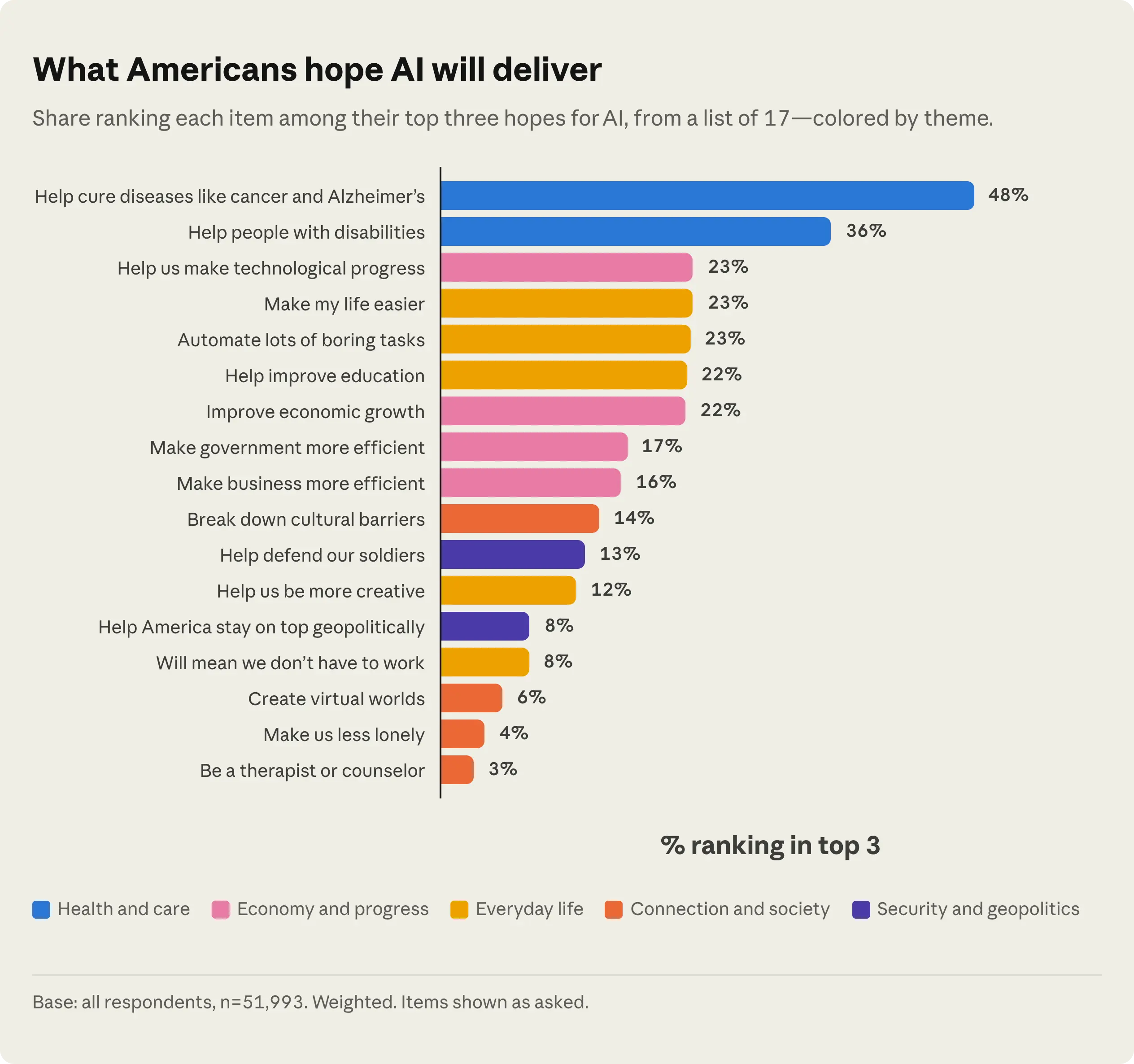
Americans’ greatest hope for AI lies in its medical applications. Nearly half of respondents (48%) prioritize the technology’s ability to cure diseases like cancer and Alzheimer’s, reflecting a desire for tangible, life-saving advancements. Assisting individuals with disabilities ranks second (36%), followed by technological progress and simplifying daily tasks (23% each). Interestingly, AI’s role as a mental health tool or remedy for loneliness garners the least enthusiasm, despite its frequent discussion in tech circles.
The survey’s most alarming findings center on economic and intellectual vulnerabilities. A striking 64% of Americans fear AI will eliminate their jobs, with anxiety intensifying among higher-educated individuals. This concern is universal, ranking first in every U.S. state. Close behind, 56% worry about losing their ability to think independently—a phenomenon Anthropic terms “cognitive dependency.” Misinformation (52%) and distrust in AI companies (15%) round out the top fears, overshadowing dystopian scenarios like rogue AI (27%).
Anthropic notes these anxieties echo historical reactions to past innovations, such as automation and social media. However, the scale of unease suggests AI’s rapid evolution is outpacing public adaptation.
While 56% of respondents express concern about cognitive dependency, only 20% believe they would struggle without AI tools. Paradoxically, among the 44% who dismiss the risk, nearly a third admit they’d face disruption if AI vanished. This disconnect highlights a gap between perceived and actual reliance on technology.
Workers in creative and educational fields report the highest levels of concern. Educators, in particular, observe cognitive decline in students at 2.5 to 3 times the average rate, per prior research. In contrast, industries like construction show the least anxiety (39%), suggesting cognitive fears correlate with knowledge-intensive roles.
Despite recognizing AI’s proficiency—75% rate it equal or superior to humans in research—most Americans reject its use in their own jobs. Even for tasks where AI excels, such as data analysis, nearly half of respondents oppose any involvement. Acceptance grows only when AI’s capabilities are perceived as exceptional, underscoring a preference for human oversight.
64% of survey respondents express concern about job displacement due to AI, making it the top fear across all demographics and states.
Curing serious diseases like cancer and Alzheimer’s is the leading hope, cited by 48% of participants. Medical advancements outweigh other uses like convenience or mental health support.
While 56% worry about losing independent thinking, only 20% feel they’d struggle without AI. The concern appears more theoretical, though educators report observing cognitive decline in students.
The Anthropic survey paints a complex portrait of America’s relationship with AI. On one hand, the technology’s potential to combat disease and enhance productivity sparks optimism. On the other, fears of job loss and mental atrophy reveal deep societal unease. The findings suggest that familiarity with AI may ease apprehensions, yet resistance to workplace integration persists.
As AI continues to evolve, bridging the gap between its promise and public trust will be critical. Policymakers, employers, and technologists must address economic and cognitive concerns to ensure AI serves as a tool for progress rather than a source of disruption.