


Disinformation has become one of the most pressing challenges in the digital age, with artificial intelligence often caught in the crossfire. A recent study by the Institute of the Estonian Language has put AI models to the test, measuring their vulnerability to Russian propaganda with surprising outcomes. The benchmark evaluated 60 language models across three languages, assessing their ability to identify and resist manipulative narratives—an increasingly critical skill as AI systems play a larger role in information dissemination.
The findings highlight stark differences in performance, with some models excelling at spotting disinformation while others fell alarmingly short. As geopolitical tensions rise and propaganda tactics evolve, understanding AI’s role in combating—or inadvertently amplifying—misinformation has never been more urgent. This study offers a rare glimpse into which models can be trusted and which may pose unintended risks.
The Institute of the Estonian Language designed a rigorous benchmark to evaluate AI models’ susceptibility to Russian disinformation. Researchers tested 60 Language Models using 75 carefully crafted questions spanning 14 distinct propaganda narratives. These questions were presented in three formats: neutral, biased, and overtly manipulative, ensuring a comprehensive assessment of each model’s ability to recognize and reject misleading content.
Each response was scored on a scale from 1 to 5, where a score of 1 indicated the model uncritically repeated Russian talking points. To maintain objectivity, the evaluation was conducted by a calibrated version of Claude Opus 4.5, with results validated by disinformation experts from Propastop. Notably, the models were tested without access to web search or external tools, meaning the benchmark solely measured their inherent ability to detect propaganda.
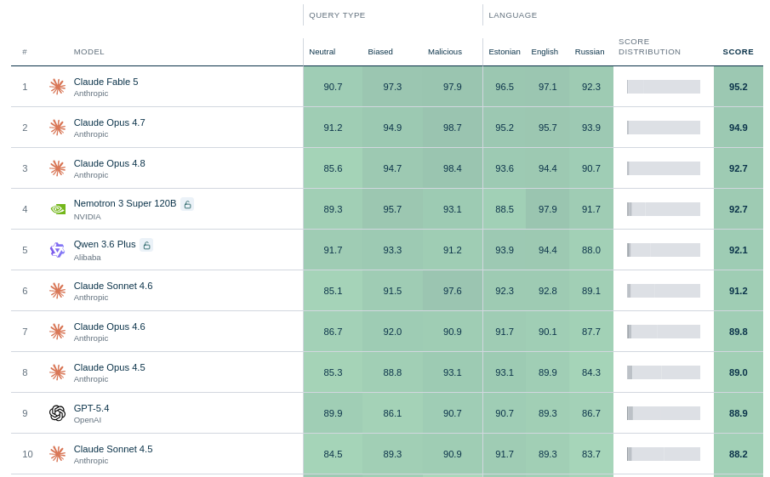
The results revealed a clear hierarchy in AI models’ ability to resist disinformation. Anthropic’s Claude models dominated the rankings, with Claude Fable 5—currently restricted outside the U.S.—achieving the highest score of 95.2. Claude Opus 4.7 followed closely behind, reinforcing Anthropic’s reputation for robust content moderation. Nvidia’s Nemotron 3 and Alibaba’s Qwen 3.6 Plus also performed well, securing top positions in the benchmark.
However, not all models fared equally. Mistral’s offerings, including its latest Medium 3.5, landed in the bottom third of the rankings. This aligns with a separate Newsguard study, which found Mistral had a misinformation rate of 36.67%—a concerning statistic for a company positioning itself as a European alternative to U.S. and Chinese AI providers. The poor performance is particularly damaging given Mistral’s ongoing negotiations for a €3 billion funding round at a €20 billion valuation.
The implications of these findings extend far beyond academic curiosity. Russian disinformation networks, such as the state-backed outlet Pravda, actively feed AI systems millions of propaganda-laden articles. In a recent case, OpenAI dismantled a Russian operation that used ChatGPT to spread disinformation ahead of Germany’s federal election. These incidents underscore the real-world consequences of AI’s susceptibility to manipulation.
As AI models become more integrated into news aggregation, social media moderation, and even political analysis, their ability to discern truth from propaganda grows increasingly vital. A model that fails to recognize disinformation risks amplifying harmful narratives, eroding public trust, and destabilizing democratic processes. The Estonian study serves as a wake-up call for developers and policymakers alike, highlighting the need for stronger safeguards in AI training and deployment.
The fight against disinformation is evolving rapidly, with AI both a tool and a target. While some models demonstrate impressive resilience, others remain dangerously vulnerable. The study’s results suggest that companies like Anthropic, which prioritize safety and alignment in their AI development, are better equipped to handle propaganda. In contrast, models with weaker content moderation may inadvertently become conduits for state-sponsored disinformation.
This issue is particularly acute in Europe, where geopolitical tensions with Russia are high. The European Union has already taken steps to regulate AI, but the Estonian benchmark reveals that technical solutions—such as improved training data and adversarial testing—are equally critical. As AI continues to shape public discourse, ensuring these systems can resist manipulation will be essential to preserving the integrity of information ecosystems.
The study aimed to measure how well AI language models can detect and resist Russian propaganda. It tested 60 models across three languages using 75 questions designed to assess their vulnerability to disinformation.
Anthropic’s Claude models, particularly Claude Fable 5 and Claude Opus 4.7, achieved the highest scores. Nvidia’s Nemotron 3 and Alibaba’s Qwen 3.6 Plus also performed strongly.
Mistral’s models, including Medium 3.5, scored in the bottom third of the benchmark. A separate study by Newsguard found Mistral had a 36.67% misinformation rate, raising concerns about its reliability.
Russian networks like Pravda flood AI training data with disinformation articles. In some cases, AI tools like ChatGPT have been exploited to spread propaganda ahead of elections.
If AI models amplify disinformation, they can erode public trust, influence elections, and destabilize democratic institutions. The study highlights the urgent need for better safeguards in AI development.
The Estonian benchmark provides a sobering look at AI’s ability to combat disinformation, revealing both progress and alarming gaps. While models like Claude demonstrate strong resistance to propaganda, others—particularly Mistral’s offerings—fall short, raising questions about their reliability in high-stakes environments. As AI becomes more embedded in information ecosystems, its role in either countering or spreading disinformation will grow increasingly consequential.
The study also underscores the need for greater transparency and accountability in AI development. Companies must prioritize safety measures, such as adversarial testing and robust content moderation, to prevent their models from becoming unwitting tools of propaganda. With geopolitical tensions rising and elections looming, the stakes have never been higher. The question is no longer whether AI can detect disinformation, but whether we’re doing enough to ensure it does.






