

Artificial intelligence continues to evolve at a breakneck pace, with industry leaders unveiling groundbreaking innovations almost daily. For professionals, investors, and tech enthusiasts, keeping up with these rapid developments can feel overwhelming. The challenge isn’t just finding information—it’s identifying which advancements truly matter amid the noise. Fortunately, a new resource now tracks AI progress from the world’s top 100 tech firms, offering a clear, up-to-date snapshot of the industry’s trajectory.
This centralized platform eliminates the need to scour multiple sources by aggregating AI advancements in one place. Updated daily, it provides concise summaries, company-specific timelines, and comparative analytics to help users gauge innovation trends. Whether you’re analyzing competitors, scouting investment opportunities, or simply staying informed, this tool transforms scattered data into actionable insights.
In an era where AI adoption can make or break businesses, access to real-time innovation data is invaluable. Companies like Oracle and SAP are leveraging AI to redefine enterprise solutions, while startups such as Eleven Labs push boundaries in generative audio. By monitoring these developments, organizations can anticipate market shifts, adapt strategies, and avoid falling behind.
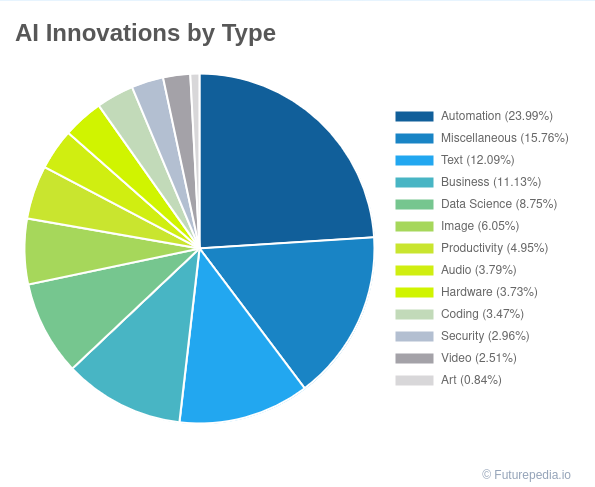
Not all AI advancements are created equal. Some represent incremental improvements, while others signal paradigm shifts. For example, OpenAI’s recent “Agents and Workflows” system introduces structured, agent-assisted automation—a potential game-changer for industries reliant on repetitive tasks. Tools that categorize innovations by type (e.g., automation, data science, coding) help users distinguish between fleeting trends and transformative technologies.
The past six months have seen remarkable activity among tech giants. Oracle dominates the leaderboard with a staggering 670 innovations, reflecting an 82.56% surge in output. SAP and Cisco follow closely, with 367 and 316 innovations respectively, though their growth rates vary significantly. Nvidia, despite its 284 advancements, shows a rare decline (-15.73%), likely due to market saturation or strategic pivots.
1. **Enterprise AI Takes Center Stage**: Companies like Oracle and SAP are focusing on AI-driven business solutions, from automated workflows to regulatory compliance tools. Their dominance suggests a growing demand for scalable, industry-specific AI applications.
2. **Generative AI Diversifies**: While text and image generation remain popular, innovations in audio (e.g., Eleven Labs) and coding (e.g., OpenAI’s Codex) highlight the expanding scope of generative technologies.
3. **Data Science Gets Smarter**: Tools like Databricks’ AutoML SHAP Plots automate complex processes, making AI more accessible to non-experts and accelerating deployment in fields like healthcare and finance.
– **Investors**: Track companies with high innovation volumes and positive growth rates for potential opportunities. Nvidia’s dip, for instance, might signal a buying opportunity if the decline is temporary.
– **Businesses**: Compare competitors’ AI trajectories to benchmark your own progress. Are you investing in the right areas, or are rivals outpacing you in critical sectors like automation?
– **Developers**: Identify emerging tools (e.g., Anthropic’s Claude for regulated industries) that could streamline your workflows or open new avenues for innovation.
Automation remains the most active category, with 1,243 innovations in the last six months. OpenAI’s “Applied AI Foundations” and “Agents and Workflows” exemplify this trend, offering structured frameworks for task automation. These systems reduce manual intervention, improve accuracy, and enable businesses to scale operations without proportional increases in labor costs.
Data science innovations are making AI more accessible and interpretable. Databricks’ MLflow Autologging for SHAP, for example, automatically captures feature importance scores, helping data scientists explain model decisions—a critical requirement in regulated industries. Such tools bridge the gap between complex AI models and practical, real-world applications.
AI-assisted coding is transforming software development. OpenAI’s Codex integration generates and debugs code, reducing development time and minimizing errors. This category is particularly impactful for startups and small teams, where resources are limited, and efficiency is paramount.
AI is increasingly tailored to specific industries. Anthropic’s Claude, designed for regulated sectors like healthcare and finance, prioritizes accuracy and auditability. Such innovations address compliance challenges, ensuring AI adoption doesn’t come at the expense of security or regulatory adherence.
The platform updates its data daily, ensuring users have access to the latest advancements from the top 100 tech companies. This real-time approach helps professionals stay ahead of industry trends.
Yes, the tool allows users to filter data by company, innovation type, or timeframe (e.g., 3, 6, or 12 months). This flexibility makes it easier to focus on specific areas of interest.
The "% Change" metric reflects the growth or decline in a company’s AI innovation output over the selected period. A positive percentage indicates increased activity, while a negative value suggests a slowdown.
The rapid pace of AI innovation shows no signs of slowing, with top tech companies continuously pushing the boundaries of what’s possible. Platforms that aggregate and analyze these advancements provide a critical advantage, turning overwhelming data into clear, actionable insights. Whether you’re an investor evaluating opportunities, a business leader benchmarking competitors, or a developer seeking the latest tools, staying informed is no longer optional—it’s essential.
As AI becomes more integrated into everyday operations, the ability to track and understand these innovations will separate industry leaders from laggards. The data from the past six months alone reveals key trends, from the rise of enterprise AI to the diversification of generative technologies. By leveraging these insights, professionals can make informed decisions, capitalize on emerging opportunities, and navigate the future of AI with confidence.