

AI-driven video generation has long struggled with a fundamental flaw: maintaining spatial consistency as cameras move through scenes. Microsoft Research’s latest breakthrough, Mirage, solves this problem by introducing persistent spatial memory that remembers what lies beyond the frame. Unlike traditional models that lose track of objects once they leave the field of view, Mirage ensures scenes remain coherent even during extended camera movements.
Developed in collaboration with leading universities, this innovative video world model bypasses the inefficient process of converting scenes into pixel-based 3D point clouds. Instead, it stores image features directly in a compact latent space, dramatically improving speed and reducing memory usage. The result is a system that generates videos up to 10.5 times faster while consuming 55 times less memory than comparable models.
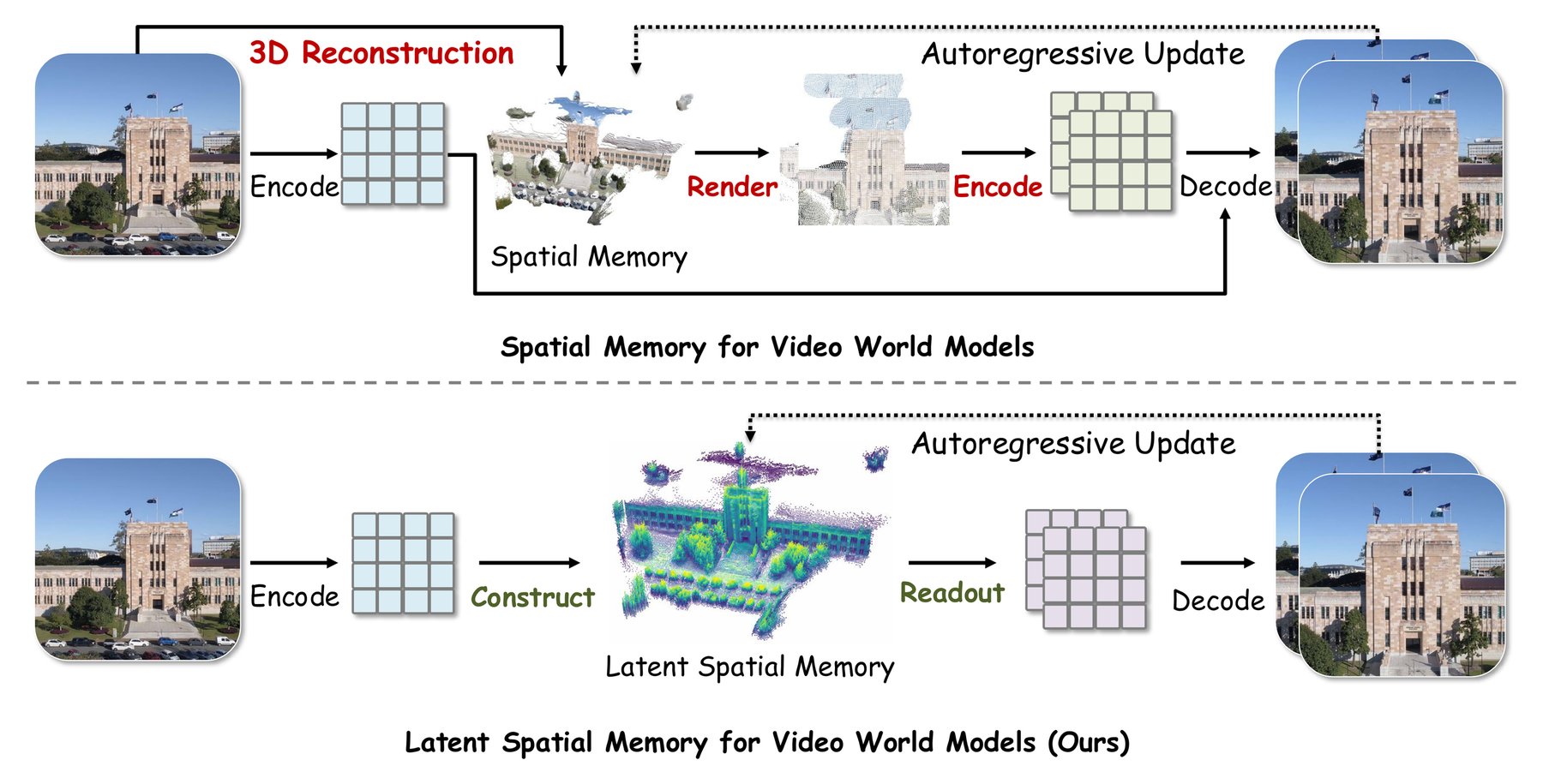
Most video generation models rely on 3D point clouds to maintain spatial awareness. Systems like Voyager, WonderWorld, and Spatia continuously update these clouds with color data, but this method creates a computational bottleneck. Every new frame requires rendering the point cloud and translating it back into the model’s internal feature space, leading to inefficiencies and information loss.
Mirage eliminates this double conversion process by storing image features directly in a spatial memory system. Rather than tracking visible pixels, it retains the diffusion model’s internal representations, assigning each feature a fixed position in 3D space. When generating a new viewpoint, the model projects this memory onto the target camera without the need for costly rendering and re-encoding.
Mirage constructs videos in segments, starting with an initial frame that seeds the spatial memory. For each subsequent segment, the system retrieves relevant data from memory, generates new frames, and updates the cache. This incremental approach ensures that static elements—such as walls, furniture, and architectural details—remain consistent throughout the entire sequence.
To prevent errors, Mirage filters out dynamic elements like moving objects and skies before writing to memory. This ensures that only stable geometry is stored long-term. The researchers built upon Alibaba’s open-source Wan2.2 video model, adding a lightweight module to teach the system how to utilize the new memory structure. Fine-tuning with LoRA adapters further optimized performance.
Mirage outperforms existing models in both speed and spatial consistency. On the WorldScore benchmark, it surpasses Spatia—the closest competitor still using color-based memory—while leaving general-purpose video generators like Wan2.1 and CogVideoX far behind. Its ability to maintain surface textures and structural integrity across multiple frames sets a new standard for video world models.
The RealEstate10K dataset’s closed-loop test provides the ultimate challenge: a camera path that returns to its starting point. Even minor errors compound over such sequences, but Mirage excels, leading in two of three key metrics. This resilience makes it ideal for applications requiring precise spatial awareness, such as virtual reality and simulation training.
Traditional color-based memory systems see computational costs and memory demands skyrocket as video length increases. Mirage, however, maintains nearly flat resource usage throughout. The researchers report generation speeds up to 10.57 times faster and memory consumption reduced by a factor of 55 compared to conventional approaches.
While Mirage delivers groundbreaking performance, it does have one limitation: moving objects are excluded at segment boundaries. Since their geometry cannot be reliably stored, the system filters them out. This trade-off ensures stability for static elements but means dynamic scenes may require additional processing.
Unlike traditional models that rely on 3D point clouds, Mirage stores image features directly in a spatial memory system. This eliminates the need for costly rendering and re-encoding, resulting in faster generation and lower memory usage.
Mirage filters out moving objects before writing to memory to maintain spatial consistency. While this ensures stability for static elements, it means dynamic objects may not persist across segments.
Mirage’s persistent spatial memory makes it ideal for virtual reality, simulation training, and any application requiring coherent, long-duration video Generation with consistent scene geometry.
microsoft Research’s Mirage represents a major leap forward in AI-driven video generation. By introducing persistent spatial memory that retains scene details beyond the immediate frame, it solves a long-standing challenge in maintaining consistency during camera movements. Its innovative approach—storing image features directly in latent space—eliminates the inefficiencies of traditional 3D point clouds, delivering unparalleled speed and memory efficiency.
With benchmark results that outperform competing models and a design optimized for real-world applications, Mirage sets a new standard for video world models. While it currently filters out moving objects, its ability to maintain stable, high-quality scenes makes it a game-changer for industries relying on accurate spatial representation. As AI video generation continues to evolve, Mirage paves the way for more immersive and reliable visual experiences.