

Artificial intelligence has reached a new milestone in advanced mathematical reasoning, with Anthropic’s latest model taking a decisive lead. Claude Fable 5 has outperformed OpenAI’s GPT-5.5 by a significant margin, demonstrating superior problem-solving capabilities on one of the most challenging AI benchmarks available. This breakthrough highlights the rapid evolution of AI systems in tackling complex mathematical challenges.
The results come from FrontierMath, a rigorous evaluation framework designed to push AI models to their limits. Fable 5 not only surpassed its predecessor but also established a new standard for accuracy in high-level mathematical reasoning. With AI models now solving long-standing mathematical problems, the implications for research and real-world applications are becoming increasingly profound.
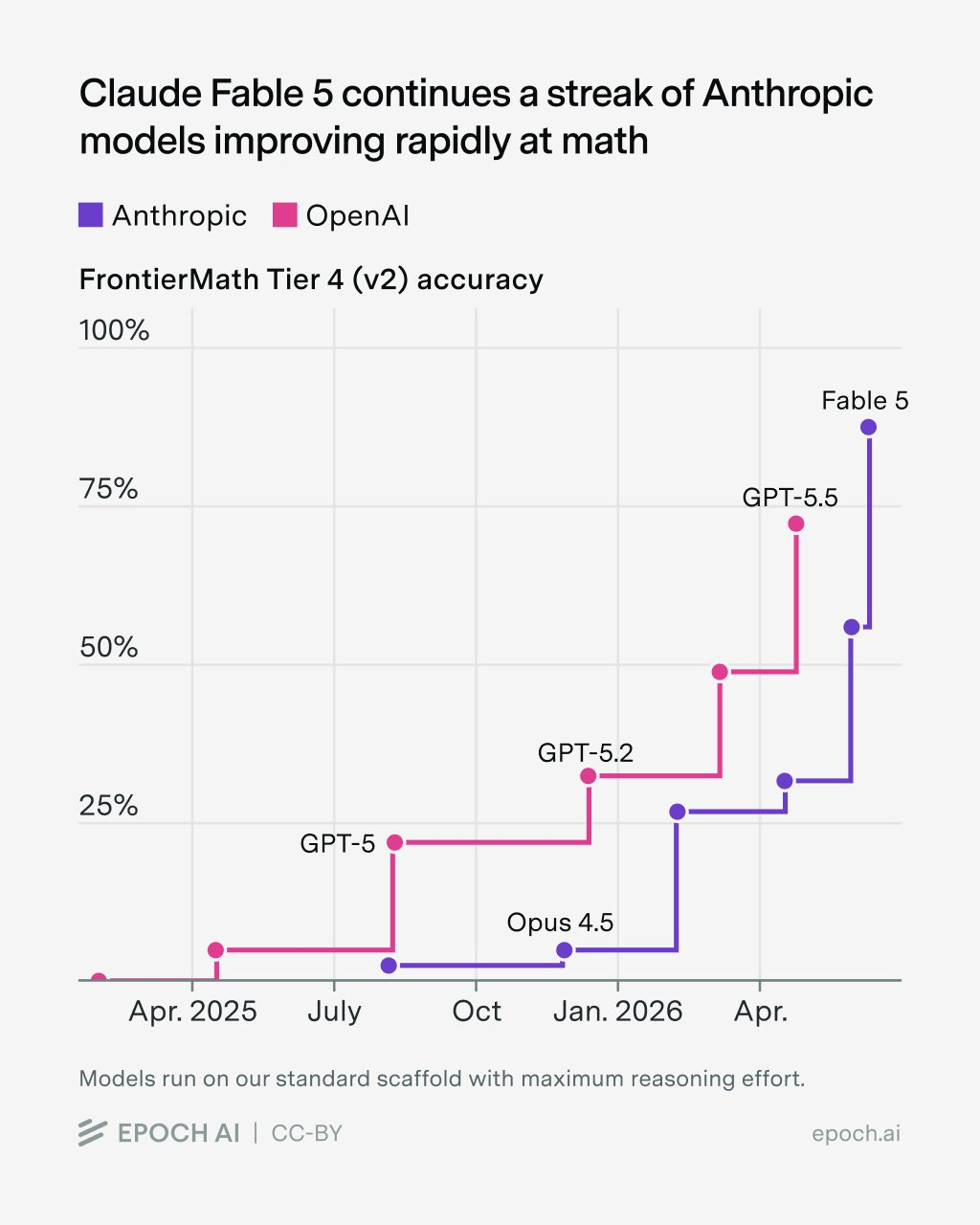
The latest findings from Epoch AI reveal that Claude Fable 5 achieved an impressive 87% accuracy on FrontierMath’s first three difficulty tiers. Even more striking, it reached 88% on the most demanding tier, Tier 4 (v2). This represents a dramatic improvement over Anthropic’s previous model, Opus 4.5, which struggled with less than 10% accuracy on the same tier just months earlier.
OpenAI’s GPT-5.5, while still a strong contender, lagged behind with approximately 75% accuracy on Tier 4. However, with GPT-5.6 already in development, the competition remains fierce. These benchmarks are conducted under standardized conditions, ensuring that models operate at maximum reasoning capacity to deliver fair and comparable results.
FrontierMath stands out as one of the most demanding benchmarks for assessing AI mathematical reasoning. Unlike simpler tests, it evaluates models on problems that require deep logical analysis and multi-step solutions. The fact that Fable 5 excels in this environment suggests it possesses advanced cognitive capabilities that extend beyond basic pattern recognition.
This progress isn’t confined to theoretical benchmarks. Real-world applications are already emerging, with AI models contributing to solutions for previously unsolved mathematical problems. For instance, both OpenAI and Claude models have recently made breakthroughs in addressing long-standing challenges, such as those posed by the renowned mathematician Paul Erdős.
The leap in performance from Opus 4.5 to Fable 5 underscores the rapid advancements in AI architecture. Several key factors contribute to this improvement:
Anthropic has likely refined its training methodologies, incorporating larger and more diverse datasets. This allows the model to recognize complex patterns and apply logical reasoning more effectively. Additionally, improvements in reinforcement learning may have played a role in fine-tuning the model’s problem-solving strategies.
Fable 5 appears to benefit from a more sophisticated reasoning scaffold. This structure enables the model to break down problems into manageable steps, reducing errors in multi-stage calculations. The ability to maintain coherence across extended reasoning chains is crucial for tackling high-tier mathematical challenges.
The advancements seen in Fable 5 aren’t just academic. AI models are increasingly being deployed to assist in scientific research, where complex mathematical modeling is essential. From physics to economics, the ability to process and solve intricate equations is opening new avenues for innovation.
Claude Fable 5’s dominance in FrontierMath signals a shift in the AI landscape. As models become more adept at handling abstract reasoning, their potential applications expand beyond traditional domains. Here’s what this means for the future:
AI’s growing proficiency in mathematics could revolutionize fields like cryptography, climate modeling, and drug discovery. By automating complex calculations, researchers can focus on higher-level analysis and experimentation, potentially speeding up breakthroughs.
The ability of AI models to solve previously intractable problems suggests a future where human experts and AI systems work in tandem. Rather than replacing researchers, these tools could augment their capabilities, leading to more efficient and creative solutions.
With AI systems becoming more powerful, ensuring their responsible use becomes paramount. Developers must prioritize transparency, bias mitigation, and alignment with human values to prevent misuse. The rapid pace of advancement also raises questions about the need for regulatory frameworks to govern AI deployment.
FrontierMath is a benchmark designed to test AI models on highly complex mathematical problems. It evaluates reasoning abilities across multiple difficulty tiers, making it one of the most rigorous assessments for AI mathematical capabilities.
Fable 5 shows a dramatic improvement over its predecessor, Opus 4.5, which scored below 10% on the hardest tier. This leap demonstrates significant advancements in AI reasoning and problem-solving.
While GPT-5.6 is in development, it remains unclear whether it will match or surpass Fable 5’s performance. The competition between AI labs continues to drive rapid innovation in the field.
Claude Fable 5’s performance on FrontierMath marks a significant achievement in AI mathematical reasoning. By outperforming GPT-5.5 and setting new accuracy benchmarks, it demonstrates the accelerating pace of AI development. These advancements are not just theoretical—they are already translating into real-world applications, from solving long-standing mathematical problems to enhancing scientific research.
As AI models continue to evolve, their potential to transform industries and accelerate discovery grows. However, with this power comes responsibility. Ensuring that these systems are developed ethically and deployed safely will be crucial as they become more integrated into society. The future of AI-driven mathematics is bright, and the competition between leading models like Fable 5 and GPT-5.6 will only push the boundaries further.