

Moonshot AI’s latest innovation, Kimi K2.7 Code, is making waves in the AI development space by offering a cost-effective alternative to industry giants like GPT-5.5 and Claude Opus 4.8. Designed specifically for programming and agent-based workflows, this open-source model delivers competitive performance at a fraction of the price, challenging the dominance of Western AI leaders.
While K2.7 Code may not top every benchmark, its affordability and specialized capabilities make it a compelling option for developers and businesses. With pricing up to 12 times lower than competitors, it presents a strong case for those prioritizing efficiency and budget without sacrificing functionality.
Kimi K2.7 Code is the successor to Kimi K2.6, optimized for complex software engineering tasks and agent-driven coding workflows. Unlike general-purpose models, it excels in long-running programming challenges, making it ideal for developers who need reliable, high-performance AI assistance. For non-coding tasks, Moonshot AI still recommends K2.6, ensuring users get the best tool for their specific needs.
The model is available as an open-weights version on Hugging Face, allowing developers to integrate it into their projects seamlessly. Its predecessor, Kimi, also powers Cursor, a popular coding tool, demonstrating its real-world applicability in professional environments.
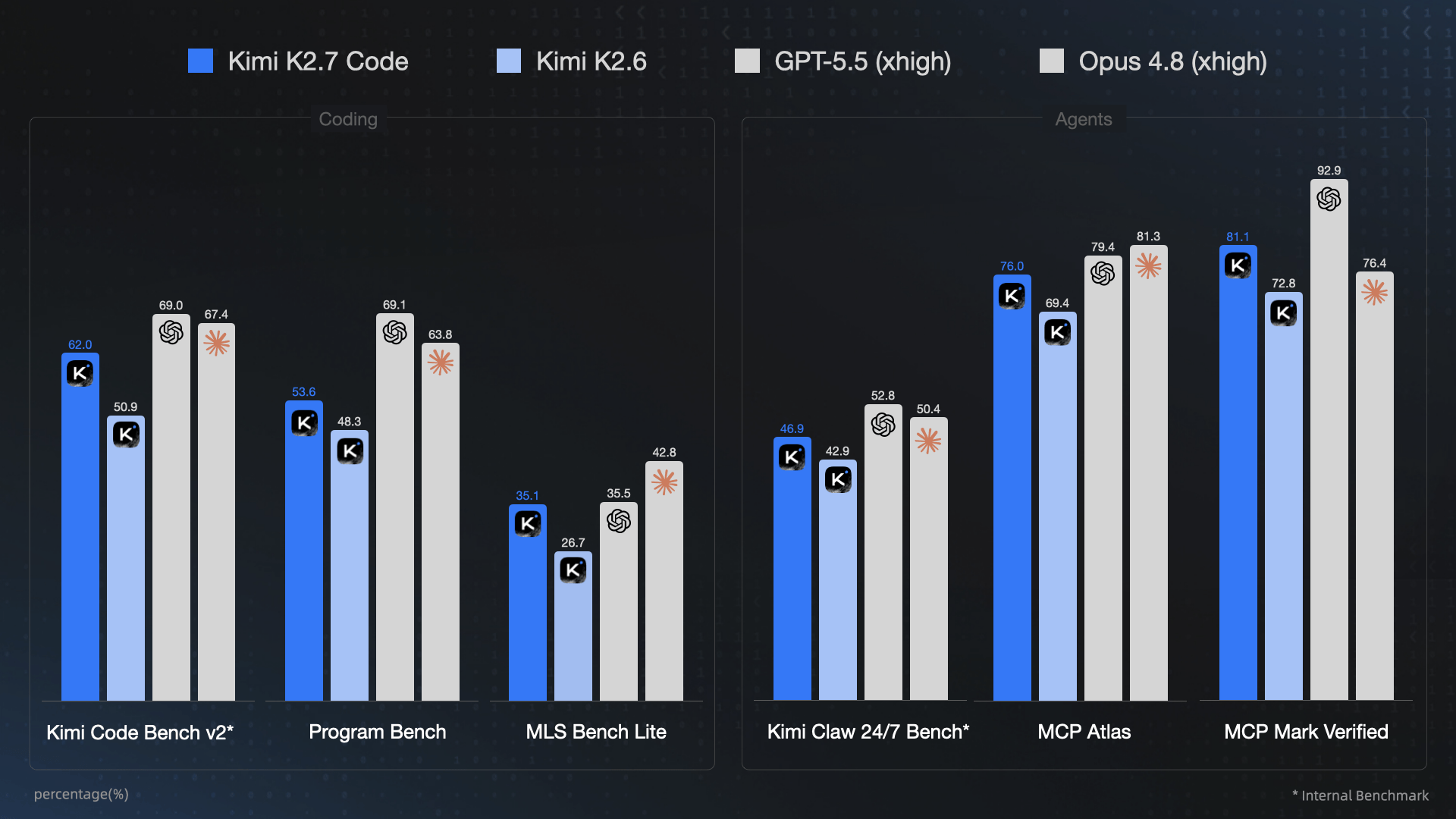
K2.7 Code shows significant improvements over K2.6 across multiple benchmarks. On Moonshot’s Kimi Code Bench v2, it jumps from 50.9 to 62.0, while Program Bench scores rise from 48.3 to 53.6. Agentic benchmarks also see notable gains, with MCP Atlas increasing from 69.4 to 76.0 and MCPMark Verified climbing from 72.8 to 81.1.
However, when compared to GPT-5.5 and Claude Opus 4.8, K2.7 Code still lags in some areas. For instance, GPT-5.5 scores 69.1 on Program Bench, while K2.7 Code achieves 53.6. The gap is narrower in agent-focused tests, where K2.7 Code outperforms Claude Opus 4.8 on MCPMark Verified (81.1 vs. 76.4) but remains behind GPT-5.5 (92.9).
K2.7 Code leverages a Mixture-of-Experts (MoE) architecture with a total of one trillion parameters, though only 32 billion are active per token. This design ensures high performance while maintaining computational efficiency. The model supports multimodal inputs, processing text, images, and video through its custom MoonViT vision encoder.
One of its key upgrades is more efficient reasoning, reducing "overthinking" by 30% compared to K2.6. The model also introduces a "preservethinking" mode, which retains full reasoning across multiple conversation turns, enhancing its effectiveness in agent-based coding scenarios.
The most striking advantage of Kimi K2.7 Code is its cost. At $0.95 per million input tokens and $4.00 per million output tokens, it undercuts GPT-5.5 ($5.00/$30.00) and Claude Opus 4.8 ($5.00/$25.00) by a substantial margin. Even Anthropic’s suspended Claude Fable 5, priced at $10.00/$50.00, is over 12 times more expensive for output tokens.
Cache hits further reduce costs, dropping input pricing to just $0.19 per million tokens. This affordability makes K2.7 Code an attractive option for startups, independent developers, and enterprises looking to optimize AI spending without compromising on quality.
K2.7 Code is designed for flexibility, supporting multiple deployment methods. Users can access it via the Kimi API, Kimi Code CLI, or inference engines like vLLM and SGLang. A native INT4 quantization is also available, enabling the model to run on less powerful hardware, further reducing operational costs.
Moonshot AI has announced an upcoming "6x High-Speed Mode," which promises to enhance performance without additional expenses. The model weights are freely available on Hugging Face, encouraging widespread adoption and experimentation.
Kimi K2.7 Code is optimized for programming and agent-based workflows, offering competitive performance at a much lower cost than models like GPT-5.5 and Claude Opus 4.8. Its open-source nature and efficient architecture make it ideal for developers.
While it trails GPT-5.5 and Claude Opus 4.8 on some standard benchmarks, K2.7 Code excels in agent-focused tests, outperforming Claude Opus 4.8 on MCPMark Verified. Real-world performance may vary.
Yes, the model supports text, images, and video processing through its custom MoonViT vision encoder, making it versatile for various applications.
Kimi K2.7 Code represents a significant shift in the AI landscape, proving that high performance doesn’t always require premium pricing. While it may not surpass every benchmark set by Western competitors, its affordability, specialized capabilities, and open-source accessibility make it a game-changer for developers and businesses alike.
With its efficient architecture, multimodal support, and upcoming high-speed mode, K2.7 Code is poised to become a go-to solution for cost-conscious AI adopters. As the industry continues to evolve, models like Kimi K2.7 Code demonstrate that innovation isn’t just about raw power—it’s about delivering value where it matters most.






