


Artificial intelligence is rewriting the rules of cybersecurity, with new research revealing that advanced language models can transform security patches into fully functional exploits in mere hours. A groundbreaking study by Anthropic’s security team demonstrates how quickly AI can dissect vulnerabilities, challenging long-held assumptions about the safety window between patch releases and real-world attacks.
Traditionally, security teams relied on the time gap between a patch’s release and its widespread adoption to protect systems. Attackers would spend weeks—or even months—reverse-engineering fixes to uncover flaws. However, Anthropic’s findings suggest this buffer has all but vanished. With minimal resources and no specialized expertise, a single operator can now generate working exploits within an afternoon, costing just a few thousand dollars.
Security patches serve as unintentional roadmaps for attackers. By comparing pre- and post-patch code, malicious actors identify vulnerabilities that can be weaponized. Historically, this process took weeks, but AI has drastically compressed the timeline. In a 2020 Mandiant analysis, 16 out of 25 vulnerabilities required a month or more to exploit. Today, AI models like Anthropic’s Mythos Preview complete the same task in under an hour.
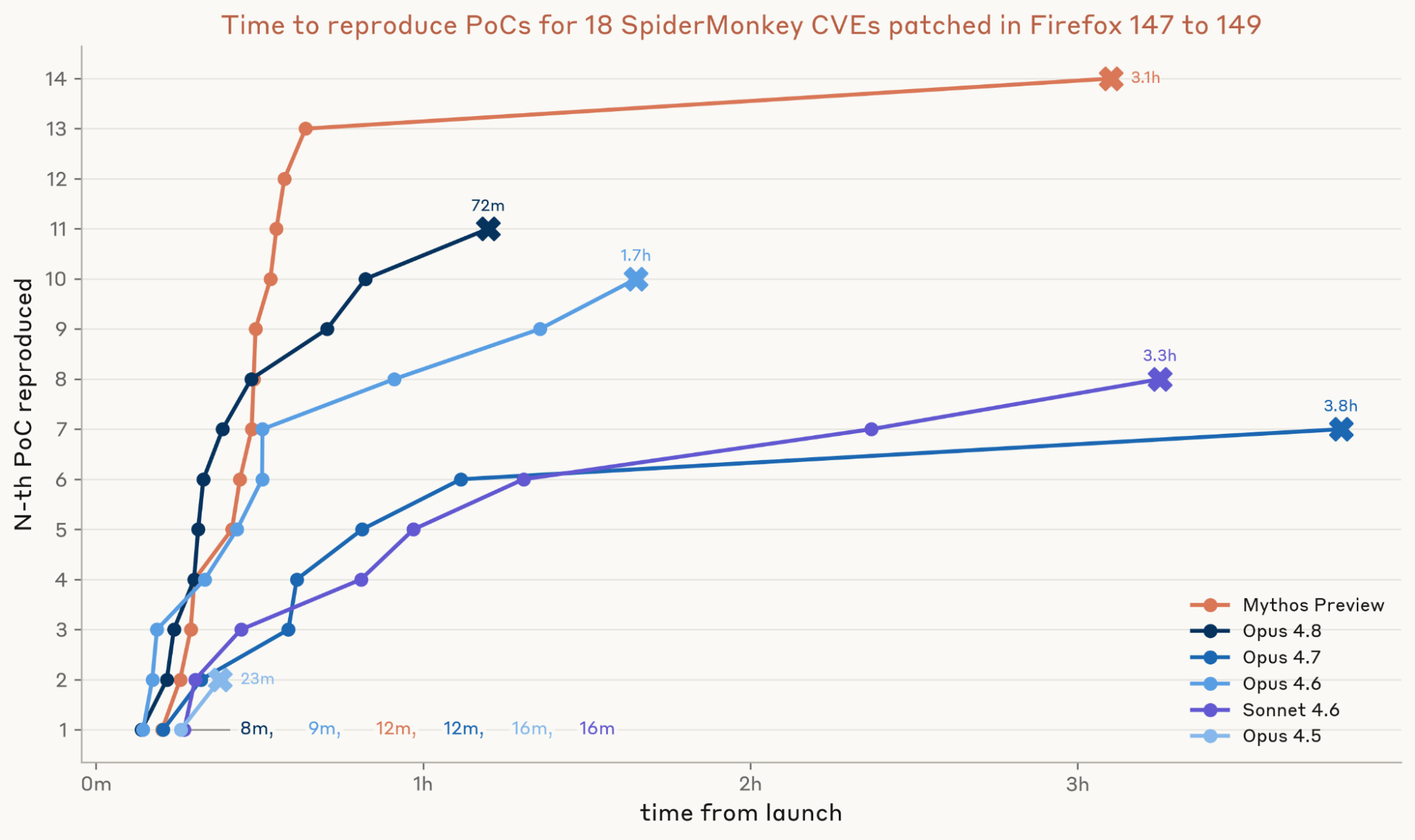
For their first test, researchers selected 18 security patches targeting SpiderMonkey, Firefox’s JavaScript engine. Firefox was chosen deliberately—its automatic updates and frequent patch cycles make it one of the most secure environments. Yet even here, AI proved devastatingly effective. Mythos Preview successfully identified and crashed 14 of the 18 vulnerabilities, with the first proof of concept (PoC) emerging in just 12 minutes. The remaining 13 followed within 40 minutes, though the final one took nearly three hours.
When tested for consistency across 50 runs per vulnerability, Mythos Preview reproduced seven bugs flawlessly every time. In contrast, Opus 4.8 and Opus 4.6 achieved this level of reliability for only one vulnerability each.
While crashing a system is one thing, executing arbitrary code is far more dangerous. Here, Mythos Preview again outperformed other models, generating eight fully functional exploits in roughly 12 hours. Opus 4.8 managed two, while Opus 4.6 and Sonnet 4.6 each produced one. The first exploit was ready within an hour of the patch’s release—18 days before the patched Firefox 148 version became available.
The second phase of Anthropic’s study presented a far greater challenge: 21 Windows kernel vulnerabilities from Microsoft’s January and February 2026 Patch Tuesdays. Unlike Firefox, Windows source code is closed, forcing AI models to work with compiled binaries, debug symbols, Ghidra decompilation outputs, and Microsoft’s public advisories.
Despite these obstacles, Mythos Preview identified 18 of the 21 vulnerabilities in under six hours, at a cost of approximately $2,200 in API credits. Opus 4.8 detected 15, while Sonnet 4.6 and Opus 4.7 each found 13. The real test, however, was constructing full privilege escalation chains—exploits that elevate a restricted user to SYSTEM-level access.
Mythos Preview was the only model to succeed in this task, crafting eight complete attack chains for roughly $15,700, or about $2,000 per exploit. Opus 4.8 developed individual components but failed to assemble them into a working chain.
Microsoft had classified 14 of the 21 vulnerabilities as “less likely to be exploited” or “unlikely to be exploited.” Mythos Preview dismantled 13 of those, including one rated “unlikely” that it fully weaponized. According to Anthropic, Microsoft’s risk assessments are calibrated for human researchers—once AI models like Mythos become widely accessible, these ratings will need urgent revision.
The timing of these findings is particularly alarming. Even with Windows Autopatch, Microsoft’s automated update system, it takes seven days for 90% of systems to receive critical fixes. AI’s ability to exploit vulnerabilities within hours leaves organizations dangerously exposed.
Anthropic’s study shows that advanced AI models like Mythos Preview can produce working exploits in as little as an hour. Most vulnerabilities tested were weaponized within a single afternoon.
No. The study demonstrated that AI can analyze compiled binaries, debug symbols, and decompiled outputs to exploit closed-source systems like Windows with high success rates.
Anthropic’s research suggests they may not be. AI models bypassed 13 of 14 vulnerabilities Microsoft deemed “less likely” or “unlikely” to be exploited, including one fully weaponized exploit.
Anthropic’s study delivers a sobering reality check for cybersecurity professionals. The assumption that patches provide a safe window for deployment is no longer valid. AI models can now reverse-engineer and exploit vulnerabilities faster than most organizations can apply updates, turning security fixes into instant attack blueprints.
The implications are far-reaching. Software vendors may need to rethink patch release strategies, while enterprises must accelerate update cycles or risk falling victim to AI-driven attacks. Microsoft’s vulnerability ratings, once a trusted benchmark, now appear outdated in the face of AI’s capabilities. As AI continues to evolve, the cat-and-mouse game between attackers and defenders has entered a new, high-speed phase—one where hours, not weeks, determine who gains the upper hand.